Ribosomes: the factory every cancer depends on
Cancer cells grow fast. To do that, they need to build proteins at an enormous rate.
 Dr. Younes Medkour
November 2025 · 5 min read
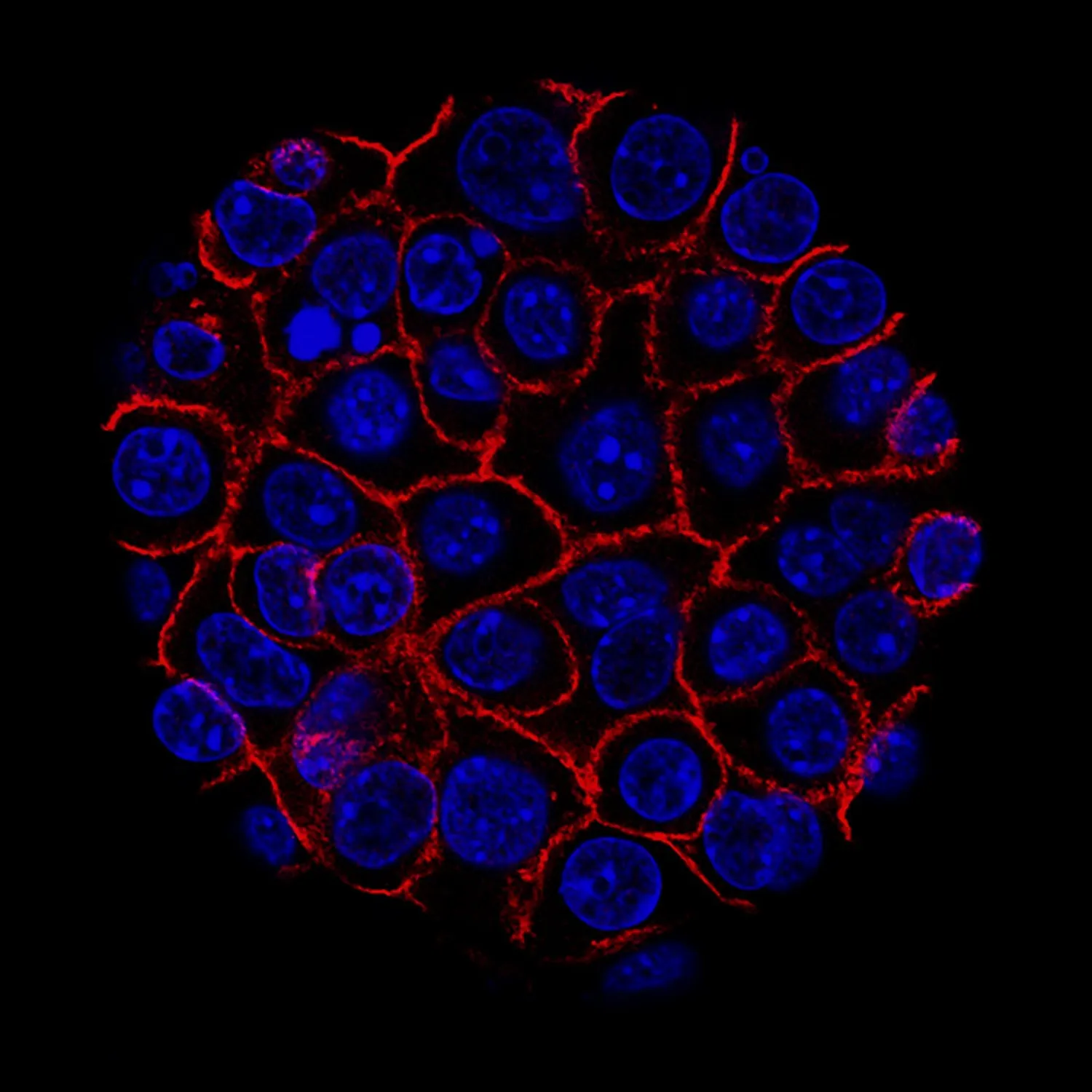
Every protein in your body is made by a ribosome, a molecular machine built from RNA and dozens of proteins. A single cell can contain millions of them.
Ribosomes read the instructions carried by messenger RNA and link amino acids together, one by one, into proteins. They are among the most abundant and most expensive structures a cell makes. Building them requires producing large amounts of ribosomal RNA, making dozens of ribosomal proteins, and assembling everything in the right order. A large share of a growing cell’s energy goes into this one task.
Why cancer cells care
A cell that divides quickly has to double its contents, including its proteins, every time. That means building ribosomes constantly. Many cancer cells are, in effect, ribosome factories, and some are visibly marked by enlarged nucleoli, the part of the nucleus where ribosomes are assembled.
Pathologists have noticed this for a long time. Large, prominent nucleoli are one of the features that can distinguish an aggressive tumour cell under the microscope. It is a visible sign of a cell that has turned up its protein-making machinery to keep up with constant growth.
Many of the signals that drive cancer feed directly into this process. Growth pathways that are often overactive in tumours, including mTOR, push cells to make more ribosomes. In a sense, ribosome production is where many different cancer-causing signals converge.
A vulnerability
If ribosome production is that important to cancer, slowing it down should hurt cancer more than healthy tissue. Researchers have developed drugs that target the first step of ribosome production, and some have reached clinical trials.
Sometimes the best way to stop a growing system is to cut its supply line.
That first step is the transcription of ribosomal RNA genes. Healthy cells that divide slowly need far less of it, so in principle they can tolerate a reduction better than tumour cells that depend on it. It is the same logic behind many cancer treatments: find something the tumour needs more than the rest of the body does, and take it away.
The caveat is that some healthy tissues also divide quickly, and many existing chemotherapies already affect ribosome production as part of how they work. The challenge is to target the process precisely enough to spare normal cells.
Where my work fits
In triple-negative breast cancer, I studied a complex of three proteins, PML, mTOR and RONIN, that turns down the genes needed for ribosomes. When that happens, the cells stop dividing.
Triple-negative breast cancer is a difficult disease to treat because it lacks the receptors that targeted hormonal and antibody therapies rely on. That makes it important to find other weak points. Understanding how cells naturally switch off ribosome genes gives us a clearer picture of a brake that tumours may be trying to escape.
My perspective
I find this way of thinking about cancer useful. Instead of focusing only on killing tumour cells directly, we can ask what they depend on and how to take it away.
Sometimes the best way to stop a growing system is not to attack it, but to cut its supply line.