First-author paper: a PML–mTOR–RONIN brake on triple-negative breast cancer
My first-author paper shows how three proteins work together to stop triple-negative breast cancer cells from dividing.
 Dr. Younes Medkour
2025
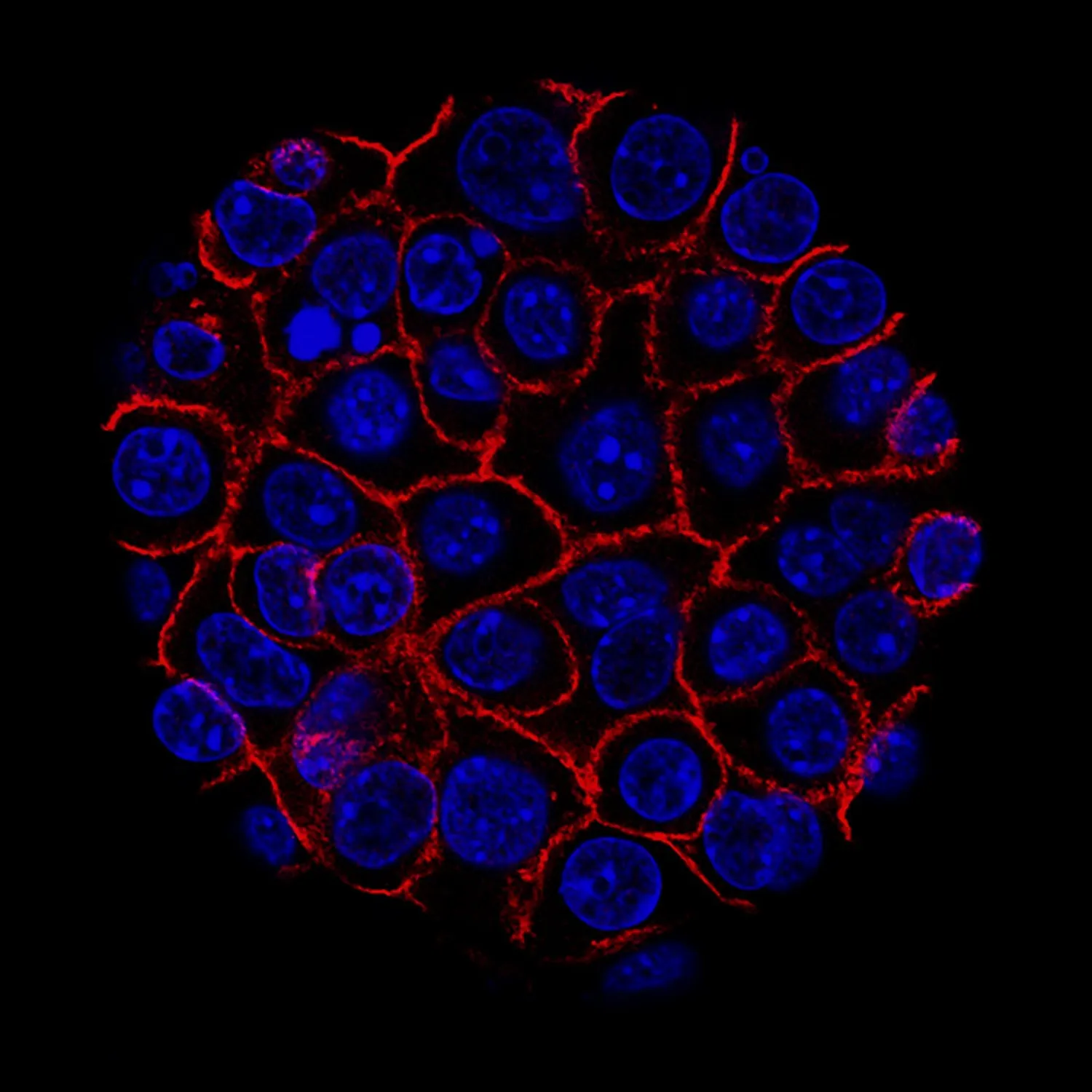
In 2025, I published a first-author paper on triple-negative breast cancer, one of the hardest forms of breast cancer to treat because it lacks the receptors most targeted drugs act on.
Most breast cancers carry estrogen receptors, progesterone receptors or the HER2 protein, and each of those gives clinicians a specific target. Triple-negative tumours have none of the three. That leaves chemotherapy as the main option, and it tends to be a more aggressive disease. Finding new vulnerabilities in these cells is one of the clearest unmet needs in breast cancer research.
The finding
Three proteins, PML, mTOR and RONIN, come together in one complex. That complex regulates the genes the cell needs to build ribosomes, the machines that make every protein. When ribosome production is turned down, the cancer cells enter senescence: they stay alive, but stop dividing.
Each of these proteins was known on its own. PML is a well-studied tumour suppressor. mTOR is the central switch that tells a cell whether conditions are right to grow. RONIN is a regulator of gene expression. What this work shows is how they act together, and that their combined effect lands on one of the most resource-intensive processes in the cell.
Why it matters
Cancer cells need enormous protein production to keep growing. A mechanism that shuts that down from the inside is a lead for therapies that halt growth.
Once you know what to change inside a cell, you need a way to deliver it there safely.
Ribosome production is an attractive weak point because cancer cells depend on it more than most normal cells do. A dividing tumour cell has to double its protein content before it splits, and that requires a constant supply of new ribosomes. Cutting that supply does not need to kill the cell outright to be useful. Pushing it into senescence takes it out of the growing population.
There are caveats. Senescent cells are not always harmless, and a mechanism identified in cultured cells still has to hold up in more complex models before anyone can talk about treatment. What a study like this provides is a clear map of a control point, which is what drug development needs in order to start.
Full circle
My PhD started with how cells age and stop dividing. This paper is the same idea, turned against cancer. It is also what led me to my current focus: once you know what to change inside a cell, you need a way to deliver it there safely.
My perspective
I find it striking how often the same pathways appear in aging and in cancer. mTOR is the clearest example. In aging research, turning it down is associated with longer life. In cancer, the same logic can be used to stop growth. Seeing that connection from both sides has convinced me that these fields should talk to each other far more than they do.
It also made the delivery problem impossible to ignore. Knowing the target is one thing. Getting a therapy into the right cells, without harming the rest of the body, is where many good ideas stall. That is the problem I want to work on next.