Concordia University Magazine features our work linking aging and cancer
Aging and cancer share more biology than most people think. Concordia featured our lab’s work on that link.
 Dr. Younes Medkour
September 2016
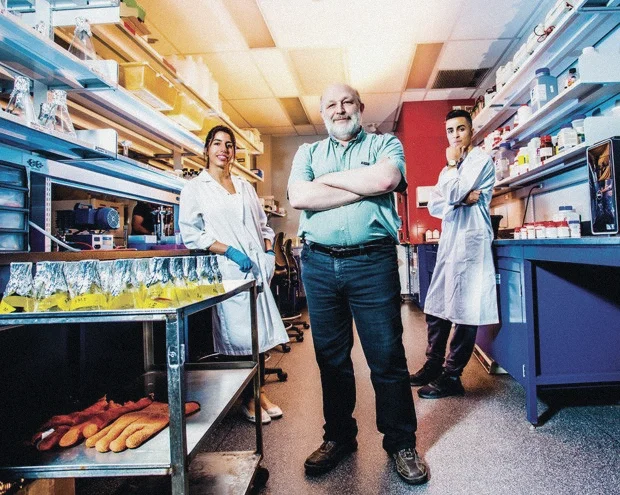
In September 2016, Concordia ran a feature on our lab called “A natural cure for cancer.” The headline was bigger than the science, as headlines often are, but the idea behind it is real, and it is worth explaining properly.
Vladimir Titorenko put it simply: we study the aging of baker’s yeast to understand how to slow aging and extend the healthy lifespan of humans. Most cancers are diseases of aging. So molecules that change how cells age are worth testing against cancer too.
Why yeast tells us anything about people
It can sound odd that a single-celled fungus could teach us about human disease. But many of the core systems that control how a cell grows, uses energy, handles stress and eventually declines were in place long before animals existed. Yeast shares a large part of that machinery with us. It grows fast, it is easy to manipulate genetically, and its lifespan can be measured in days or weeks rather than decades. That makes it one of the most practical places to ask basic questions about aging.
Cancer and aging are connected through that same machinery. Over a lifetime, cells accumulate damage, their stress responses weaken, and the controls that keep division in check start to fail. Age is the single biggest risk factor for most cancers. If you understand what keeps a cell healthy for longer, you are also learning something about what goes wrong when it turns malignant.
From yeast to cancer cells
One of those molecules was lithocholic acid, a bile acid our lab had found to delay aging in yeast. Our collaborators at McGill, the University of Saskatchewan and INRS-Institut Armand-Frappier then found that it selectively kills neuroblastoma, breast and prostate cancer cells in the lab.
Most cancers are diseases of aging. Molecules that change how cells age are worth testing against cancer too.
The word that matters there is “selectively.” Killing cancer cells in a dish is not hard; plenty of toxic compounds do it. What makes a molecule interesting is when it affects cancer cells while leaving normal cells largely alone. That kind of difference points to a real biological vulnerability, not just general toxicity.
My part of the work was looking at the cellular processes behind these effects: what actually changes inside the cell when it ages more slowly. Understanding the mechanism is what turns an observation into something you can build on.
Early days
Results like these come from cells in a dish. Animal studies have to come before anything reaches people, and most promising compounds never make it through that path. A bile acid that works in culture still has to reach the right tissue, at the right dose, without unacceptable side effects. That is why I am careful with words like “cure.”
My perspective
What I took from this work was less about one molecule and more about a way of thinking. Aging and cancer are usually studied by different people, in different departments, with different funding. Yet they share much of the same biology. Questions asked in one field often have answers sitting in the other.
The link stayed with me. Years later, my postdoctoral work focused directly on how cancer cells can be made to stop dividing.